AI an Enabler, not a Replacement, for Medical Professionals: Prof. Ajit Kumar Chaturvedi
News & Announcement
Prof. Ajit Kumar Chaturvedi emphasized AI as an enabler, not a replacement, for medical professionals, highlighting healthcare and research potential while stressing Indian data, clinical judgement, critical thinking, patient communication.
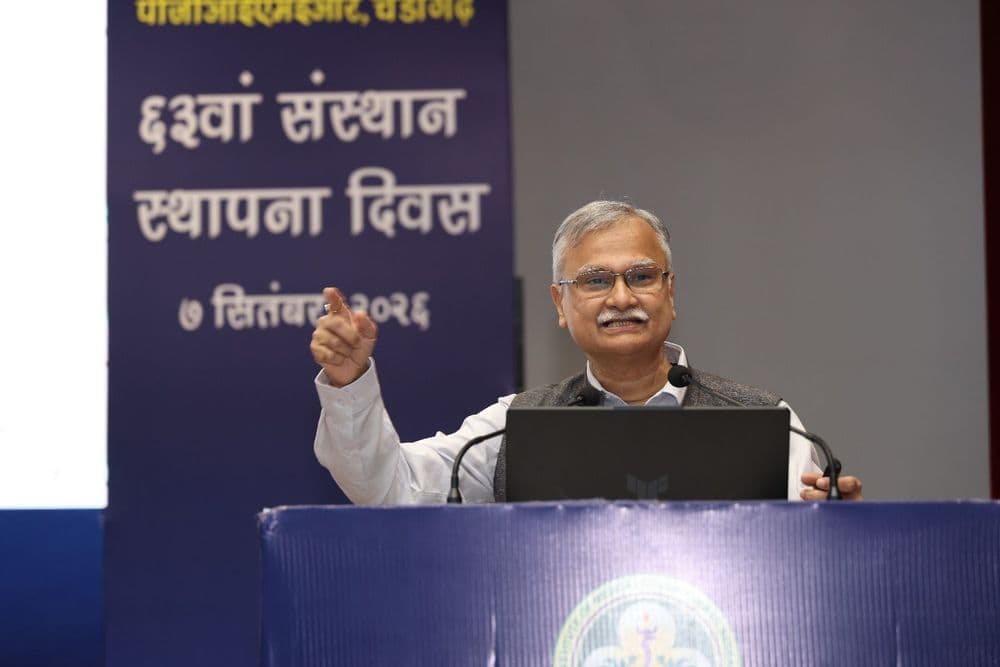
Vice-Chancellor Prof. Ajit Kumar Chaturvedi has suggested that Artificial Intelligence be seen as an enabler and facilitator, rather than a replacement, with regard to the medical profession. Underlining the growing potential of AI in medical research and healthcare, Prof. Chaturvedi also cautioned against adopting it without considering Indian healthcare realities. The Vice-Chancellor was delivering the 63rd Institute Day lecture of the Postgraduate Institute of Medical Education and Research (PGIMER), Chandigarh, on “AI in Healthcare”.
Prof. Chaturvedi said that Artificial Intelligence has moved beyond being a technological novelty and is now making deep inroads into healthcare and research. It has enormous potential in medical research, remote healthcare, radiology, hospital-management, and evidence-based decision-making. He emphasized that AI should be viewed as an enabler rather than a replacement for medical professionals. "The assistant does not replace expertise, but it dramatically expands the amount of knowledge a physician can effectively utilize," he said, "The most successful healthcare deployments today are not examples of AI replacing doctors. They are examples of AI helping doctors perform at their best."
Highlighting its potential to process vast volumes of medical information, he said AI could assist doctors in extracting information from clinical records, pathology reports, and scientific literature. On medical research, Prof. Chaturvedi observed, "The real transformation is that researchers can now ask questions that were previously too expensive or time-consuming to investigate."
Cautioning against adopting AI without considering Indian healthcare realities, the Vice-Chancellor stated that AI systems trained predominantly on Western datasets may not adequately reflect Indian disease patterns, patient populations, and clinical practices. He stressed the need for India to move from being merely a consumer of healthcare AI to becoming a creator of solutions rooted in Indian realities.
"AI is no more a fashionable toy or a status symbol. It has made very deep inroads in the market, and naturally, we cannot just keep watching from a distance," he observed. Prof. Chaturvedi said, "The first generation of AI helped humans find information. The next generation is helping humans make decisions. The generation after that will help humans take action."
Prof. Chaturvedi praised PGIMER Chandigarh as a “true national asset” which is making significant contributions to healthcare, education, research, and innovation across the country. He also stressed that medical education should increasingly focus on clinical judgement, evidence evaluation, critical thinking, and patient communication rather than memorization alone.